
How to Practise Garbh Sanskar While Working Full-Time: Morning, Workday and Bedtime Routine
December 02, 2025
Discover how maternal emotions influence fetal brain development. Explore the science behind Garbh Sanskar and tips for a positive pregnancy mindset.
Verified by: Mr. Prashant Agrawal | Updated on: December 02, 2025


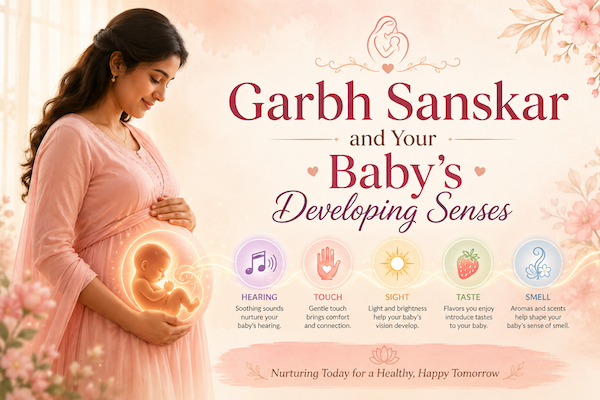

Your baby’s brain begins forming long before birth. What you feel, think, hear, and experience during pregnancy becomes part of the environment your baby grows in.
Garbh Sanskar teaches that the womb is not just a physical space.
It is the baby’s first emotional classroom. Modern science now confirms the same: prenatal emotions have a measurable impact on fetal brain development, temperament, memory formation, and emotional regulation.
This blog blends Garbh Sanskar wisdom with scientific research to explain how your emotional state during pregnancy influences your baby’s brain and how you can consciously create a positive emotional world for your child.
For many years, people believed that babies only begin responding to emotions after birth. Now we know the opposite: the womb is an active emotional and sensory environment.
Your baby receives constant biochemical signals from your body.
When you feel calm, happy, or safe, your body releases hormones that help your baby’s brain form strong, stable neural connections.
When you feel consistently stressed or anxious, stress hormones pass through the placenta and influence fetal development.
In Garbh Sanskar, this is called “emotional imprinting.” It means your daily emotional experiences become impressions (sanskar) on your baby’s developing mind.
Your baby’s brain is forming at an extraordinary pace during pregnancy. Millions of neural pathways are being built every day. Your emotions directly influence this process.
This does not mean you must be happy all the time. It simply means your baby benefits from consistent emotional safety, which Garbh Sanskar practices help cultivate.
Thoughts create emotions. Emotions create hormonal responses. Those hormones reach your baby.
This means:
Garbh Sanskar emphasizes daily self-talk practices such as:
These uplifting thoughts help stabilize your emotional chemistry and support your baby’s development.
Garbh Sanskar focuses on practical, simple ways to create an emotionally enriched environment.
These practices help keep your mind balanced, your mood uplifted, and your baby emotionally secure.
Emotional safety is not only created by the mother. A supportive father lowers stress and promotes emotional stability for both mother and baby.
Ways fathers help:
A father’s emotional support becomes part of the “womb atmosphere” too.
It’s unrealistic to assume any pregnancy will be stress-free. Garbh Sanskar teaches that occasional stress is normal, but chronic stress should be addressed.
The goal is not perfection, but emotional awareness.
For a complete, holistic understanding of Garbh Sanskar covering emotions, diet, rituals, yoga, mantras, pre-conception, and postnatal care. visit our full guide:
Garbh Sanskar – Ancient Wisdom Meets Modern Science
Yes. Emotional hormones pass through the placenta and influence your baby’s brain development, especially stress-response circuits.
Occasional crying does not harm the baby. Chronic emotional distress may influence fetal stress hormones, so gentle emotional balancing practices are encouraged.
Practices like meditation, mantras, gratitude journaling, listening to soft music, and talking to your baby help regulate emotions.
Yes. Happiness creates calm hormonal patterns that support neural development and emotional balance.
Absolutely. The father’s support reduces maternal stress and creates a safer emotional womb environment for the baby.
Short relaxation practices, reaching out for emotional support, and focusing on breathing or calming sounds can help restore balance.
Yes. Consistent positive practices—music, affirmations, breathing, connection—help reset emotional chemistry and benefit the baby.
Your emotions are part of your baby’s first experiences. Through Garbh Sanskar practices, you can turn pregnancy into a time of emotional nourishment—where your love, thoughts, and daily moments become the building blocks of your baby’s mind and heart.
With conscious emotional care, you help your baby grow into a calmer, more confident, and more connected human being.