
Best Raksha Bandhan Gift for a Pregnant Sister? Give Her Something She’ll Feel Every Day
March 24, 2026
Learn how to practice Garbh Samvad — talking to your unborn baby. Week-by-week guide, real example scripts & science. By Garbh Sanskar Guru.
Verified by: Prof. Hardik Upadhyay | Updated on: March 24, 2026

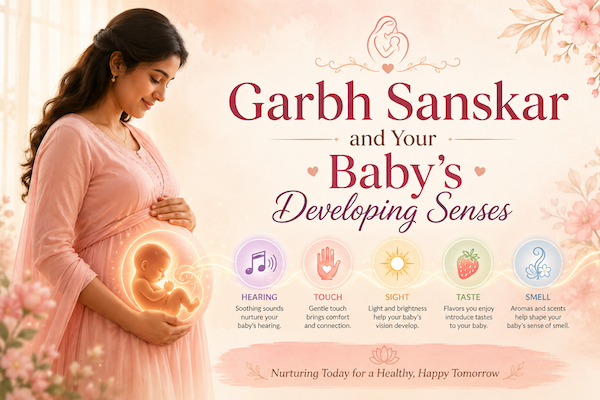
Your baby can hear you. Your baby knows your voice. And the conversations you have with your unborn child right now — before they take their first breath — are already shaping who they will become.

This is the ancient promise of Garbh Samvad (गर्भ संवाद) — and modern neuroscience has confirmed it is not mythology. It is biology.
Garbh Samvad is the practice of consciously communicating with your unborn baby through your voice, touch, thoughts, music, and intention. It is the most personal, most powerful, and most underutilised practice in Garbh Sanskar — and yet it requires no special equipment, no preparation, and no expertise. Only your presence, your voice, and your love.
In this complete guide by the expert team at Garbh Sanskar Guru — India's No. 1 Garbh Sanskar app, trusted by 20 Lakh+ mothers across 63+ countries — you will learn exactly what Garbh Samvad is, what science says about it, when to start, what to say, and how to make it a joyful daily ritual for the entire family.
The word Garbh Samvad comes from two Sanskrit roots: Garbh (गर्भ, meaning womb) and Samvad (संवाद, meaning dialogue or conversation). Together, they describe the intentional practice of maintaining conscious, loving communication with the unborn child throughout pregnancy.
In classical Vedic tradition, Garbh Samvad was one of the central practices within the broader framework of Garbh Sanskar. Ancient texts described the mother as the first and most important teacher of the child — and the womb as the first classroom. Every story she told, every mantra she chanted, every emotion she felt was understood to be a lesson the baby was already receiving.
In the modern Garbh Sanskar Guru programme, Garbh Samvad encompasses:
The Garbh Sanskar Guru app includes a complete Garbh Samvad section with guided scripts in Hindi, English, Gujarati, and Marathi — new content daily, progressing automatically as the pregnancy advances week by week.

The fetus begins developing auditory structures (the cochlea and auditory nerve) from as early as Week 8–10 of pregnancy. By Week 16, the inner ear is structurally complete enough to perceive vibrations. By Week 23–24, the baby is clearly responding to external sounds with measurable changes in heart rate, movement, and position. By Week 27–28, the baby shows clear preference responses — turning toward familiar voices and calming in response to known sound patterns.
Research in prenatal auditory neuroscience has established that the fetus does not merely hear — it memorises. Babies born to mothers who read or sang the same passage or melody consistently throughout pregnancy recognise that specific content within hours of birth — turning toward the sound source, showing reduced cortisol, and displaying calmer feeding behaviour. This is not response to familiarity alone — it is genuine prenatal memory.
Even before the baby can hear, every emotion the mother experiences creates a biochemical environment in the womb. Stress produces cortisol. Joy produces oxytocin and serotonin. Both cross the placental barrier and directly influence fetal neurological and emotional development. Garbh Samvad — particularly positive, loving verbal communication — is one of the most reliable ways to maintain the mother's biochemical environment in a state that supports the baby's optimal development. This is the epigenetic foundation of Garbh Samvad.
The father's deeper voice vibrates at a frequency that travels readily through the mother's abdominal wall and amniotic fluid, reaching the baby through bone conduction as well as sound waves. Multiple studies confirm that newborns who were regularly spoken to by their fathers during pregnancy show measurable preference for the father's voice at birth — resulting in faster postnatal bonding, calmer behaviour during father's caregiving, and stronger early attachment formation.
The peer-reviewed study by Garbh Sanskar Guru on 1,323 mothers found that mothers who practised a consistent Garbh Sanskar lifestyle — including Garbh Samvad — showed significantly improved mental well-being scores, with direct positive impact on birth outcomes including birth weight and preterm delivery risk. This is the only Garbh Sanskar-specific peer-reviewed study of its kind in India.
|
💡 The single most important thing you can do for Garbh Samvad: be consistent. Ten minutes every day produces far greater results than one-hour sessions once a week. |
Garbh Samvad in the pre-conception phase involves the couple consciously preparing their emotional environment, practising daily affirmations together, and setting their intention for the child they wish to welcome. Ancient Vedic texts prescribe specific prayers and conversations between partners before Garbhadhana (the sacred conception ritual). Garbh Sanskar Guru's pregnancy planning programme guides couples through this preparatory phase.
Although the baby cannot yet hear your words, they are fully immersed in the biochemical expression of your emotional state. In the first trimester, Garbh Samvad means keeping your emotional environment positive — through daily affirmations, gentle meditation, and short verbal conversations spoken with your hands placed on your belly. Even if nausea limits your energy, simply placing your hands on your lower abdomen and saying "I love you. You are safe. I am so happy you are here." is a complete and powerful practice.
This is the prime window for Garbh Samvad. From Week 16, the baby can perceive your voice as sound vibration. From Week 23, they actively respond. Start extending your daily Garbh Samvad to 15–20 minutes. Begin reading aloud. Introduce mantra chanting. Invite the father to speak directly to the baby. This is also the ideal time to start Garbh Sanskar classes online for structured guidance.
Your baby now knows your voice intimately. They may kick or move in response to your specific words or songs. This trimester, use Garbh Samvad to prepare your baby for birth — talking about what will happen, describing the world they are about to enter, and expressing your excitement. Research confirms that babies whose mothers practised consistent Garbh Samvad in the third trimester settle faster after birth, breastfeed more easily, and display measurably lower cortisol in the first 72 hours after delivery.
|
▶ Watch on YouTube — Majestic Garbh Sanskar Official Channel Garbh Sanskar Path:1 | Vedic Principles of Garbh Sanskar & Communication with Baby Understand the classical Vedic framework for communicating with your unborn baby — the foundation of Garbh Samvad practice. |
The most common question from mothers beginning Garbh Samvad is: "I want to do it, but I don't know what to say." Here are examples for each trimester, used in our Garbh Sanskar classes and the Garbh Sanskar Guru app.
|
Week 6–8: First Trimester: Welcoming Your Baby Sample Garbh Samvad Script: "My dearest one, I know you are here. I feel you already. You are so deeply wanted and so deeply loved. I am taking care of my body and my heart to give you the best beginning. Welcome, my little one. Welcome." |
|
Week 16–20: Second Trimester: Introducing Yourself Sample Garbh Samvad Script: "Hello my darling. I am your mother — you will know my voice better than any other voice in the world. Today I want to tell you about your family. You have a father who already loves you so much. You have grandparents who are counting the days. You are surrounded by so much love. You are so safe." |
|
Week 24–28: Second Trimester: Sharing Stories and Values Sample Garbh Samvad Script: "Today I want to tell you about a brave little boy named Dhruva, who wanted to meet God. He was told he was too small, too young. But he sat and meditated with all his heart — and God came to him. Why am I telling you this? Because I want you to know: your heart is strong enough for anything you truly want." |
|
Week 32–36: Third Trimester: Preparing for Birth Sample Garbh Samvad Script: "My sweet baby, very soon you are going to come into the world, and I am so ready to hold you. There will be bright lights and new sounds — but you will hear my voice, and you will know: you are safe. You are loved. I will be right there. We are going to do this together." |
The most effective Garbh Samvad practice happens at the same time each day — ideally morning, before the day's demands begin. Choose a quiet space. Sit comfortably with your spine upright. Place both hands on your belly. Take three slow, deep breaths to signal to your nervous system that this is a moment of presence and connection.
Always begin your Garbh Samvad with a direct, warm greeting to your baby by name (if you have one) or by an affectionate term. This consistent opener creates a learned stimulus-response pattern in the fetus — over weeks, the baby will recognise this greeting as the signal that it is time for their special time with you.
Your daily Garbh Samvad can include any of the following — rotate them to keep your own engagement fresh:
After your individual practice, invite your partner to place one hand on your belly and speak directly to the baby. Even five minutes of the father's Garbh Samvad each day — especially a repeated phrase or song — creates a prenatal memory that shapes postnatal bonding profoundly. Siblings, grandparents, and close family members can also participate, particularly from the third trimester.
Always close your Garbh Samvad with a consistent closing phrase. A simple example: "I love you. You are safe. I will see you soon." This consistent closing — used daily — becomes another learned sound pattern the baby will recognise and be soothed by after birth.
|
Get Daily Garbh Samvad Scripts in the App Week-by-week guided scripts in Hindi, English, Gujarati & Marathi — free to start. 📱 Download Free — Android (Google Play) | Download Free — iOS (App Store) Trusted by 20 Lakh+ mothers across 63+ countries | World's No. 1 Garbh Sanskar App |
Garbh Samvad and the Complete Garbh Sanskar Lifestyle
Garbh Samvad is most powerful when it is part of a complete daily Garbh Sanskar routine. The Garbh Sanskar Guru app integrates Garbh Samvad with 11 other daily practices, including:
Explore the full framework in our Complete Pregnancy Guide or book a free counselling session to get personalised guidance.
Q: What is Garbh Samvad?
Garbh Samvad is the practice of consciously communicating with your unborn baby through voice, touch, music, and intention during pregnancy. It is rooted in Vedic Garbh Sanskar tradition and confirmed by modern prenatal neuroscience. It strengthens the prenatal bond, stimulates the baby's developing senses, and supports the mother's emotional wellbeing throughout all trimesters.
Q: From which week should I start Garbh Samvad?
You can begin from the very first week of pregnancy — or even during pregnancy planning. While the baby's auditory system develops from Week 16 and clearly responds from Week 23, the mother's emotional state and biochemical environment reach the baby from conception itself. Starting early is always beneficial.
Q: What language should I use for Garbh Samvad?
Always use the language you feel most comfortable and natural in — typically your mother tongue. The baby does not learn language in the womb; what they absorb is the emotional tone, rhythm, and vibration of your voice. Hindi, Gujarati, Marathi, English — all are equally effective.
Q: Can the father also do Garbh Samvad?
Absolutely. Father's participation in Garbh Samvad is strongly encouraged and produces unique benefits. The father's deeper vocal range creates vibrations that the fetus perceives through both bone conduction and sound transmission. Babies who were regularly spoken to by their fathers in the womb show measurably faster postnatal bonding with the father.
Q: What should I say during Garbh Samvad?
Speak naturally about your love, your day, your hopes for the baby. Tell stories with positive values. Chant mantras. Read inspiring passages aloud. Sing lullabies or bhajans. The Garbh Sanskar Guru app provides guided daily Garbh Samvad scripts in four languages, advancing automatically with your pregnancy week.
Q: How long should each Garbh Samvad session be?
Start with 5–10 minutes daily in the first trimester. Build to 15–20 minutes through the second and third trimesters. Consistency is far more important than duration — 10 minutes every day produces greater results than an hour once a week.
Q: Is there a difference between Garbh Samvad and Garbh Sanskar?
Garbh Samvad is one of the most important practices within the broader framework of Garbh Sanskar. Garbh Sanskar refers to the complete lifestyle system — including yoga, diet, music, mantras, meditation, and moral stories. Garbh Samvad specifically refers to the practice of direct vocal and intentional communication with the unborn baby.
Q: Does Garbh Samvad work if I don't believe in it?
Yes. The benefits of Garbh Samvad operate through well-documented physiological mechanisms — stress hormone reduction, vocal frequency transmission to the fetus, prenatal auditory memory formation. These mechanisms are not dependent on belief. Any mother who speaks lovingly, consistently, and calmly to her baby is practising effective Garbh Samvad.
Every word you speak to your unborn baby is a gift. Every mantra you chant is a lesson. Every story you tell is a seed of character being planted in the most fertile soil that will ever exist — the developing mind of your child.
Garbh Samvad is not a technique to master or a ritual to perform correctly. It is simply the act of showing up — with your voice, your heart, and your love — and speaking to the remarkable little person growing inside you.
Join 20 Lakh+ mothers across 63 countries who have transformed their pregnancy experience with the Garbh Sanskar Guru app — the world's most comprehensive Garbh Sanskar platform, backed by peer-reviewed research and guided by 70+ domain experts.
|
Begin Your Garbh Samvad Journey — Free Today Daily scripts + guided practice + mantra library + expert classes — in 4 languages. 📱 Download Free — Android (Google Play) | Download Free — iOS (App Store) Trusted by 20 Lakh+ mothers across 63+ countries | World's No. 1 Garbh Sanskar App |
Prof. Hardik Upadhyay is Co-founder of Garbh Sanskar Guru (Majestic Garbhsanskar & Parenting Solutions Pvt. Ltd.) with 15+ years of expertise in Vedic prenatal education. He led the peer-reviewed study on 1,323 mothers validating the Garbh Sanskar lifestyle. Learn more